
No sweepin' it under the rug.

Updated: Sep 7, 2021
“I’m okay. I’ll just shove that emotion under the rug, stuff it down deep, and I’ll never have to face it. I’m strong. I don’t have the time to deal with this right now. I’ll be okay. It’ll pass. Chin up, buttercup!”
Does this script sound familiar? Chances are, especially in today’s society, it is ALL too familiar. We pretend when we don’t face our hard emotions, they go away. We pretend when we defy our emotions, they go away.
Or to our littles...”You’ll be okay. Calm down. Smile! No need to cry.” (We teach them what we’ve been taught.) Did you know kids don’t develop the limbic part of the brain that processes pain or pleasure until age 5-10, or even later with developmental delays? During this time, we, as parents, are their limbic systems and stress control system. This is why babies feel the heartbeats of their parents and young kids cling to them in unfamiliar situations. The children assess the parents’ reaction (both involuntary and voluntary) and mimic it as their truth. It is up to us to break the destructive cycle of negative emotions and to guide children down a new path. Speak life and light into them and they will believe in life and light.

Our brains do not know the difference between what someone else is saying and what we are saying. Our brains also do not know the difference between a truth and a lie. If we hear it, or even think it, our brain interprets it as truth. We have to train our brains through what we expose ourselves to and through the thoughts we allow ourselves to have. If we surround ourselves with people who speak negativity into their lives, our brains will start to think that negativity is truth and act upon it. If we allow false negative thoughts to enter our brain, it will become a truth and our lives will reflect that new truth. We have to train our brains. We have the power to speak life or death into ourselves and into those around us. We must be intentional with what we say and what we do, especially as we speak to our children. We have the power and the responsibility to train our children to know what is right and good.
Yes, pick yourself up. Dust off. Put one foot in front of the other. But do not sweep it under the rug. It is not courageous to simply move forward; what takes the greatest courage is to process what you are feeling in a healthy and positive way. One of my dear mentors, Sera Johnson, once told me, “If you don’t grow through it, you’re going to have to go through it again.” How do you grow through it? Ask yourself…
What can I learn from this experience?
How can I glorify God through the pain?
What did I learn about myself through this experience?
How can I use this experience to help others?
How could I have better processed this experience?

If we react a certain way to a particular situation repeatedly, we create a deep, physical, and visible path, good or bad, that becomes part of our cellular memory. Every time our brain encounters a similar situation, it travels the path of least resistance, the path we created. Every time we react the same way, we deepen the groove and the path becomes easier to travel and harder to deter from. We can’t control what happens to us, but we can control how we respond to it. Our thoughts become our beliefs, our beliefs become our actions, and our actions become our reality. According to Dr. Caroline Leaf, Cognitive Neuroscientist, up to 98% of all mental, physical, and behavioral illness comes from one’s thought life. Our emotions transfer to our physical well being. Which reality do you want? Live your life by design, not default.

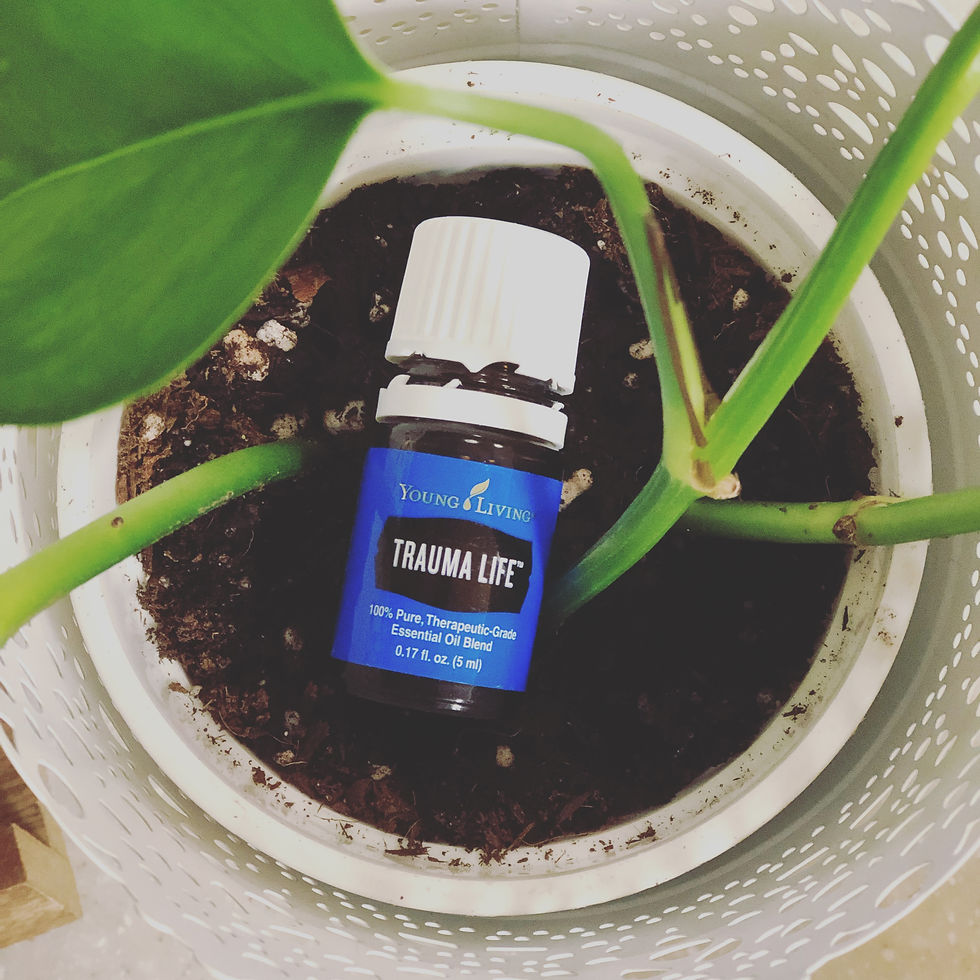
We can assist our brains in the processing of emotions by stimulating our brains through our olfactory system, AKA, our noses. Smell is the only one of the five physical senses that is directly linked to the limbic lobe of the brain, our emotional control center. When smelling something, we first have an emotional response, then a physical response; all other senses have a physical response first, then an emotional response. This means the language of emotions is aroma. The area of the brain known as the amygdala, in the limbic lobe, plays a major role in storing and releasing emotional trauma. A key way to stimulate this gland is with fragrance through the sense of smell. Since smell is the key to accessing and unlocking the emotional brain, fragrance is the key to accessing and releasing stored emotions and emotional trauma. For every emotion you experience, there is a corresponding hormone released in your body. Essential oils trigger your brain to release endorphins, hormones, etc. and chemically change the way your body is reacting. It is as if fragrance is a key to a door leading to emotional healing.
Learn more by reading my booklet “Emotional Patterns: Neuroplasticity and Forging New Pathways” at https://www.unboundbethany.com/educational-links?lightbox=dataItem-jm7dr5n91
Now go break those bonds and live unbound!
Go to https://www.youngliving.com/us/en/referral/1434961 to join my Young Living team And start your wellness journey!


Comments